
As we leave Katherine and head west, the Victoria HIghway is a lot quieter, mostly because compared to the Stuart HIghway there is less traffic, but also because most of the grey nomads have migrated south to escape the heat. We travel through the savannah of long grass and scattering of trees. Kapok trees (Cochlospermum fraseri) appear at the sides of the road, leafless in the dry season, with their big, bright yellow flowers and green seeds. A flowering kapok indicates that freshwater crocs have laid their eggs and can be collected as a source of food, and the long cotton like hairs inside the seeds are used for body decoration in Aboriginal ceremonies. Agile wallabies are not as apparent, but we still see the occasional one near the road. We pass by tropical looking creeks with Screw Pine (Pandanus spiralis)'s long green strappy leaves growing out in a spiral pattern that becomes more apparent as the leaves drop, leaving a "drill bit" trunk. The leaves are useful for making into baskets, bags, mats, shelters, neck or arm bands, footwear, string, fish traps, or mashing as a headache cure; the fruits can be roasted, the seeds can be ground into a flour (or stored); the central part of the upper stem used to treat stomach pain or sore gums; the tree itself a very useful habitat for small wildlife, including the remarkable and distinctive Double-barred finch which find it great for nests with its spiral form and small thorns providing protection and structure. These birds could be useful during the end of the dry season when the creeks are all drying out, as they are never far from water. Their nest, along with a handful of other tropical birds, is often placed next to an active wasp's nest, which might form some kind of protection to the eggs from predators?
There are also plenty of areas that have been recently burnt to tidy up country. 30 km along we reach a rest area with a tank with no water. We are hoping to find water at the next rest area as the stupidly hot days mean we have to ration our intake in the 200 km or 300 km stretches between roadhouses or towns, because we can only carry so much, and rationing water on hot days isn't great for your health while we are travelling in dehydration temperatures. Thankfully, the rest area at the 54 km mark had water so we were able to top up our supplies, taking a weight off our minds. In the afternoon we find a dry creek bed with shade, so sit and drink water with electrolytes added, watching the agile wallabies by the creek, the Brahman cattle, orange lacewing butterflies and small birds move about. We camp about 5 km from the Mathison rest area on a fence track, where as night falls some cows kick up dust until they see us and trample off into the long grass, making a huge amount of noise, to avoid us.

Next morning we ride into the Mathison rest area and there is no water in the tank. As we ride on, a few cows see us and cross the road to join their friends, making a noise, and walking daintily, as they cross the road like they are wearing high heels, which reminds me of this sign I saw in North Queensland once.
There are also plenty of areas that have been recently burnt to tidy up country. 30 km along we reach a rest area with a tank with no water. We are hoping to find water at the next rest area as the stupidly hot days mean we have to ration our intake in the 200 km or 300 km stretches between roadhouses or towns, because we can only carry so much, and rationing water on hot days isn't great for your health while we are travelling in dehydration temperatures. Thankfully, the rest area at the 54 km mark had water so we were able to top up our supplies, taking a weight off our minds. In the afternoon we find a dry creek bed with shade, so sit and drink water with electrolytes added, watching the agile wallabies by the creek, the Brahman cattle, orange lacewing butterflies and small birds move about. We camp about 5 km from the Mathison rest area on a fence track, where as night falls some cows kick up dust until they see us and trample off into the long grass, making a huge amount of noise, to avoid us.

Next morning we ride into the Mathison rest area and there is no water in the tank. As we ride on, a few cows see us and cross the road to join their friends, making a noise, and walking daintily, as they cross the road like they are wearing high heels, which reminds me of this sign I saw in North Queensland once.

The heat is really starting to affect our morale. The temperature in the shade is about 37 degrees by 2pm, a lot hotter out in the open with the road radiating back at us. We usually have to put head nets on before long because the hundreds of little flies that come with dry cattle country enjoy our salty faces too much, and try flying up our noses; and the nets only make for a warmer ride or rest stop, and extreme difficulty in eating food. We try to divide and conquer our days, getting on the road before the sun where possible and riding 20 km before breakfast, riding until 10 am to find shade and rest for 30 minutes, then riding til 12 and resting for an hour if we can find enough shade. After that we ride until 3 pm and hide in whatever shade we can find until 4.30pm and ride until sunset or until the sun gets too low and its in our eyes (which means its in the drivers eyes and we are less visible). We hardly eat anything in the heat because cooking is abhorrent, eating just makes us more thirsty, or it warms our bodies up more as they work to digest things, and the flies or ants get to the food before you can even stick it in your mouth. One day I ate five cashews, 2 oat biscuits and a bit of fruit all day. We're still riding around 115 or 130 km a day despite the challenges. By September this country is desperate for moisture, and most of the wildlife we see are probably out looking for water along with us.
We ride into Judbarra (Gregory National Park) with its rocky outcrops. There are plenty of red-tailed black-cockatoos that we scatter from the trees as we ride along, as well as scaring Pheasant Coucals from the ground next to the road, with their interesting feathers that make me think of those found in an American Indian headdress, their untidy tails looking glued on from another bird as they barely leave its preferred habitat amongst the long tall grass to fly away, landing clumsily amongst some grass or low in a tree. We make it to Victoria River roadhouse and pay for a campsite down the back. We enjoy the air conditioned bar, eating a proper meal and following it up with ice creams, watching blue-faced and dusky honey eaters out the window, as well as crows walking around with their mouths open, trying to cool themselves with throat ruffling. Just before sunset we walk to the bridge (and causeway) over the Victoria River, an amazing outlook to red escarpments with the wide river between it. The river reflects the sky and escarpment above it perfectly. Swifts and kites fly over us, while agile wallabies, cattle and the occasional brown quail crash amongst the long grass beside the river. We see a freshwater crocodile, its smaller form and sharp snout distinguishing it from the larger form with more knobbly hide, and more square-nosed salty. Freshies teeth are designed for catching and holding small prey.


We stay another day at the Victoria River roadhouse, riding out 2 km early in the morning to see the escarpments just to the east and west of Victoria river in the new morning sun, before it got too warm. We spend most of the time in the air conditioned restaurant reading, as there is insufficient shade to keep a tent cool or to sit under the whole day to rest. We enjoy their meals, cold drinks, icecream and not-melted-to-liquid chocolate bars. We talk strategy about how we are going to be able to survive the heat. Do we ride back to Darwin and catch a flight south? No. We decide, given our schedule (have to go back to work at the start of next year) and the heat, to ride on to Broome and catch a flight to Perth, where we will pick up the Munda Biddi trail and hopefully have enough time to ride home. Again that night before sunset to visit the river, this time spotting a small saltwater crocodile. Tiny, cute microbats fly above us, snapping up insect in drammatic flights of dips and turns. Returning to the roadhouse for yet another icecream, a truckie asks me "Are you the crazies on the bicycles?" "That would be us" "I don't know how you do it" "Yeh, it's too fucking hot" As we head to the tent for sleep we hear agile wallabies crashing about in the long grass and also the crazy sounding 'woop-woop-woop' of distant Pheasant Coucals.


Next morning, we head off before sunrise into the amazing escarpments and ridgelines just up the road from Victoria River. It's an amazing place, possibly one of my favourites in Australia, and surprisingly not that well known due to its remoteness. The red rocks soak up the glowing pigments of the sunrise like blotting paper for orange paint. We find our first boab tree, its silvery grey bark shimmering gold at the start of day. A whip snake crosses the road in front of me, its head raised 10 cm off the bitumen. I stop and wait for it to cross the road, where it climbs up into a shrubby tree and looks just like one of the grey branches seconds later. We ride on and the land gets back to less inspiring savannah country. We manage to ride 90 km into Timber Creek by 12 noon. We stop here for a burger and cold drinks. Simon approached Timber Creek with some level of trepidation because last time he was here, years ago, a wheel blew up and he had to stay here for 2 weeks waiting for a replacement to be sent. I considered buying him a Timber Creek roadhouse t-shirt souvenir, because that's the kind of (schadenfreuden) person I am.


We ride on to the Bradshaw bridge which crosses over the Victoria River, between the highway and a military complex. The river is very wide here. We spot some distinctive Crimson finches drinking from the edge; we probably look all red like this in the heat and blazing sunshine as well. These probably live in the pandanus lining the river, along with other finches. Curiously I also see a white jellyfish in the water, followed by a white ray of some kind? Riding on we soon find it too hot and stop amongst some bloodwood trees for shade. Three beautiful red-winged parrots visit the tree I'm sitting under a few times while we rest in the fleeting shade. They are brilliant green with bright red wings that you cannot do nothing but marvel at when they are in flight. They kept resting on the branches above my head for a while and then suddenly one would screech like a budgie and they'd be off in a flash of emerald and chartreuse, and scarlet and blue, with erratic flight. We ride on a find a camp about 15 km from the East Baines rest area amongst some sandy boab country. A whistling kite nest is up in one of the trees, the chicks making a lot of noise; a parent in a nearby tree, half watching me as I walk around below. As the sun sets golden, the scattered light shines on the boabs, lighting them up before they are plunged into the dark. I find some boab nuts and we eat the tasty, powdery insides. Boabs are a very useful tree: the fruit pith is food, you can also grind the seeds, the roots provide water and can be used to make rope, its a habitat tree for its branches and hollows. It is also a season change indicator: approaching monsoon increases humidity and the boab rapidly grows new leaves when this happens; and it quickly drops its leaves as dry winter arrives.


We wake up at 5.30 the next morning determined for a repeat of yesterday, riding most of 100 km before noon. Quickly we make it to the rest area and are grateful there is water in the tank. We fill up, surprised there are no campers here, but everyone has either moved south or woken up early like us. The East Baines river reflects the blue sky above it, offset by the flakey shale banks of the river. We ride past a place that's called Whirlwind Plains suitably enough because we see plenty of whirlie whirlies, and pass between the Newcastle and Pinkerton Ranges. There are some especially interesting rises and rocky ridges near Saddle Creek; and the water tanks at Saddle Creek stop over did have water thankfully. A caravanner was kind enough to read us the sign above the tap saying "Water may be unsafe to drink", because clearly that's a taxing activity for us to perform by ourselves. By 2pm my bikes thermometer is reading 55.4 degrees. By 3 we have had enough. We stop in the only shade we can find without a barbed wire fence, near the bone dry Glenarra creek bed.


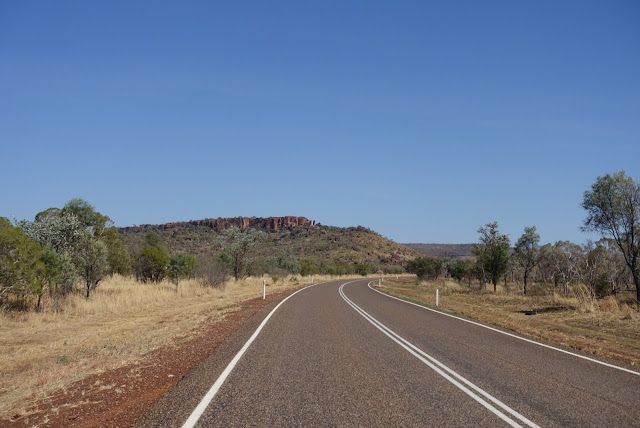


Early next morning we ride past the beautiful ranges near Keep River. We find some beautiful feathers by the side of the road, the remains of a roadkill Pheasant Coucal. We ride through the WA quarantine checkpoint at the border, setting our clocks back to 7am. There are impressive ridges amongst the Aboriginal communities, and the wonderful Carr-Boyd ranges, as we head into Kununurra at 9.30 am. While visiting the post office, I say to a local 'G'day' and the Aboriginal man says hello and asks us where we're riding to. He tells us we need to carry water because all the creeks are dry. Knowledge about country is the first thing that springs to his mind.


While in Kununurra we visit the Mirima National Park (still called Hidden Valley on some maps) early in the morning, just after sunrise. Beautiful red sandstone domes and escarpments are conveniently only 2 km from the town centre, and are well visited by local walkers, joggers and bike riders at this time of morning.


We ride into Judbarra (Gregory National Park) with its rocky outcrops. There are plenty of red-tailed black-cockatoos that we scatter from the trees as we ride along, as well as scaring Pheasant Coucals from the ground next to the road, with their interesting feathers that make me think of those found in an American Indian headdress, their untidy tails looking glued on from another bird as they barely leave its preferred habitat amongst the long tall grass to fly away, landing clumsily amongst some grass or low in a tree. We make it to Victoria River roadhouse and pay for a campsite down the back. We enjoy the air conditioned bar, eating a proper meal and following it up with ice creams, watching blue-faced and dusky honey eaters out the window, as well as crows walking around with their mouths open, trying to cool themselves with throat ruffling. Just before sunset we walk to the bridge (and causeway) over the Victoria River, an amazing outlook to red escarpments with the wide river between it. The river reflects the sky and escarpment above it perfectly. Swifts and kites fly over us, while agile wallabies, cattle and the occasional brown quail crash amongst the long grass beside the river. We see a freshwater crocodile, its smaller form and sharp snout distinguishing it from the larger form with more knobbly hide, and more square-nosed salty. Freshies teeth are designed for catching and holding small prey.


We stay another day at the Victoria River roadhouse, riding out 2 km early in the morning to see the escarpments just to the east and west of Victoria river in the new morning sun, before it got too warm. We spend most of the time in the air conditioned restaurant reading, as there is insufficient shade to keep a tent cool or to sit under the whole day to rest. We enjoy their meals, cold drinks, icecream and not-melted-to-liquid chocolate bars. We talk strategy about how we are going to be able to survive the heat. Do we ride back to Darwin and catch a flight south? No. We decide, given our schedule (have to go back to work at the start of next year) and the heat, to ride on to Broome and catch a flight to Perth, where we will pick up the Munda Biddi trail and hopefully have enough time to ride home. Again that night before sunset to visit the river, this time spotting a small saltwater crocodile. Tiny, cute microbats fly above us, snapping up insect in drammatic flights of dips and turns. Returning to the roadhouse for yet another icecream, a truckie asks me "Are you the crazies on the bicycles?" "That would be us" "I don't know how you do it" "Yeh, it's too fucking hot" As we head to the tent for sleep we hear agile wallabies crashing about in the long grass and also the crazy sounding 'woop-woop-woop' of distant Pheasant Coucals.


Next morning, we head off before sunrise into the amazing escarpments and ridgelines just up the road from Victoria River. It's an amazing place, possibly one of my favourites in Australia, and surprisingly not that well known due to its remoteness. The red rocks soak up the glowing pigments of the sunrise like blotting paper for orange paint. We find our first boab tree, its silvery grey bark shimmering gold at the start of day. A whip snake crosses the road in front of me, its head raised 10 cm off the bitumen. I stop and wait for it to cross the road, where it climbs up into a shrubby tree and looks just like one of the grey branches seconds later. We ride on and the land gets back to less inspiring savannah country. We manage to ride 90 km into Timber Creek by 12 noon. We stop here for a burger and cold drinks. Simon approached Timber Creek with some level of trepidation because last time he was here, years ago, a wheel blew up and he had to stay here for 2 weeks waiting for a replacement to be sent. I considered buying him a Timber Creek roadhouse t-shirt souvenir, because that's the kind of (schadenfreuden) person I am.


We ride on to the Bradshaw bridge which crosses over the Victoria River, between the highway and a military complex. The river is very wide here. We spot some distinctive Crimson finches drinking from the edge; we probably look all red like this in the heat and blazing sunshine as well. These probably live in the pandanus lining the river, along with other finches. Curiously I also see a white jellyfish in the water, followed by a white ray of some kind? Riding on we soon find it too hot and stop amongst some bloodwood trees for shade. Three beautiful red-winged parrots visit the tree I'm sitting under a few times while we rest in the fleeting shade. They are brilliant green with bright red wings that you cannot do nothing but marvel at when they are in flight. They kept resting on the branches above my head for a while and then suddenly one would screech like a budgie and they'd be off in a flash of emerald and chartreuse, and scarlet and blue, with erratic flight. We ride on a find a camp about 15 km from the East Baines rest area amongst some sandy boab country. A whistling kite nest is up in one of the trees, the chicks making a lot of noise; a parent in a nearby tree, half watching me as I walk around below. As the sun sets golden, the scattered light shines on the boabs, lighting them up before they are plunged into the dark. I find some boab nuts and we eat the tasty, powdery insides. Boabs are a very useful tree: the fruit pith is food, you can also grind the seeds, the roots provide water and can be used to make rope, its a habitat tree for its branches and hollows. It is also a season change indicator: approaching monsoon increases humidity and the boab rapidly grows new leaves when this happens; and it quickly drops its leaves as dry winter arrives.


We wake up at 5.30 the next morning determined for a repeat of yesterday, riding most of 100 km before noon. Quickly we make it to the rest area and are grateful there is water in the tank. We fill up, surprised there are no campers here, but everyone has either moved south or woken up early like us. The East Baines river reflects the blue sky above it, offset by the flakey shale banks of the river. We ride past a place that's called Whirlwind Plains suitably enough because we see plenty of whirlie whirlies, and pass between the Newcastle and Pinkerton Ranges. There are some especially interesting rises and rocky ridges near Saddle Creek; and the water tanks at Saddle Creek stop over did have water thankfully. A caravanner was kind enough to read us the sign above the tap saying "Water may be unsafe to drink", because clearly that's a taxing activity for us to perform by ourselves. By 2pm my bikes thermometer is reading 55.4 degrees. By 3 we have had enough. We stop in the only shade we can find without a barbed wire fence, near the bone dry Glenarra creek bed.


Early next morning we ride past the beautiful ranges near Keep River. We find some beautiful feathers by the side of the road, the remains of a roadkill Pheasant Coucal. We ride through the WA quarantine checkpoint at the border, setting our clocks back to 7am. There are impressive ridges amongst the Aboriginal communities, and the wonderful Carr-Boyd ranges, as we head into Kununurra at 9.30 am. While visiting the post office, I say to a local 'G'day' and the Aboriginal man says hello and asks us where we're riding to. He tells us we need to carry water because all the creeks are dry. Knowledge about country is the first thing that springs to his mind.


 The best shots I could manage of the West Macdonnell Ranges from the bus :(
 Simpsons Gap
  Ochre pit
  Finke River, thought to be the world's oldest
  Ormiston Gorge
 Bloodwood apples (bush coconuts)
  Bloodwood apple (bush coconut)
  Termite mounds make great wind breaks, it seems
  Beautiful range from camp
  Sunset gradients
  Scenery north of Alice
 And thank goodness
  They have signs like this in the open speed limit area!
  17%, we drank this over three nights
 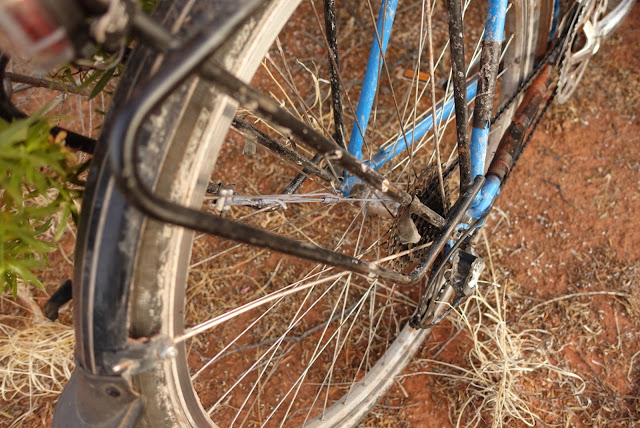 The miracle that is a kevlar spoke
  Ghan railway line
  Golden grevillea sunset
  Spring is here
 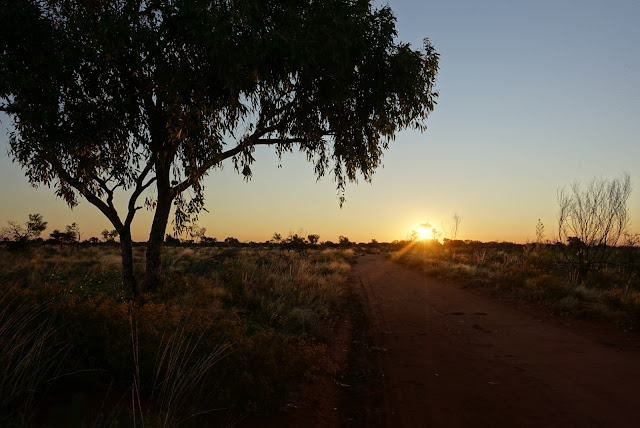 Sunset track and bloodwood, from camp


 Life savers
  Sunrise at Karlu Karlu


 Bike path to the lake
  Bike path to the lake
  View from camp
  View from camp
  If you've ever wondered what a spinifex dotted rocky ridge looks like up close
  Lake Mary Ann
 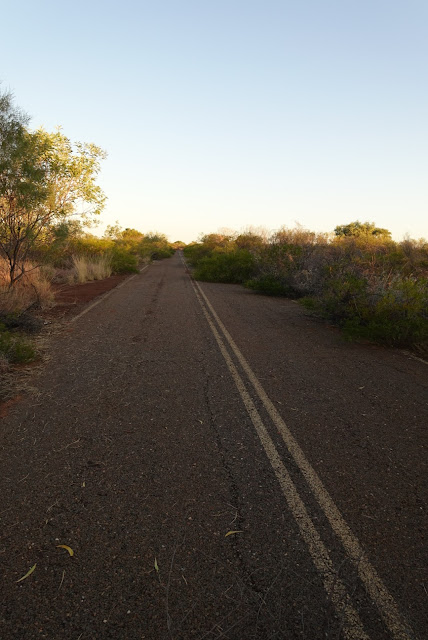 View from camp - post peak oil road, old section of Stuart Hwy
 Hot days
  Heading to camp
  Agile wallaby
  Quinine tree, not for eating
  Bush banana
  Bush banana
  Bush banana
  King River (Stuart Hwy bridge)
  King River (old railway bridge)
  since 20/5/2010